When the Water Starts Doing the Work: Cold Plunging Into Autumn
Quick Answer: Outdoor water cools more slowly than air, so the sharpest drop comes in September and October. Gradual, consistent exposure through that period builds meaningful cold adaptation, while jumping back in after a gap of several weeks removes it. Cold shock response is the main acute risk and it is most dangerous in the first minute - never swim alone in cold water, and get out well before you think you need to.
The water that felt bracing in August will feel genuinely serious by early October, and the change happens faster than most people track.

What is actually happening to water temperature right now?
It is lagging the air, which is why the coming weeks feel like the real transition.
Water has a very high heat capacity, so lakes and seas warm slowly in spring and cool slowly in autumn. Peak water temperature typically arrives weeks after peak air temperature - often late August into early September in temperate regions.
From that peak, the decline is steady and then steep. Through September and October, open water can drop several degrees per month, and the drop accelerates as air temperatures fall and daylight shortens.
Why this matters more than the number suggests:
- Below about 15 degrees, cold shock response becomes significant for unadapted people
- Below 10 degrees, safe immersion times shorten considerably
- The change from 18 to 12 degrees over six weeks is a much larger physiological difference than the numbers imply
The adaptation opportunity this creates: because the cooling is gradual, swimming consistently through autumn builds cold adaptation naturally. People who swim weekly from September into December handle water in the single digits that would be genuinely dangerous for someone entering it cold in January.
And the corollary that matters most: adaptation is lost within weeks of stopping. A person who swam all summer and takes October off is not the same person in November as one who kept going. This is the specific mistake that catches experienced swimmers.
The safety picture, stated plainly
Cold water carries real risk, and the risk is concentrated in specific moments rather than spread evenly.
Cold shock response - the first minute. Sudden immersion triggers an involuntary gasp, rapid breathing and a sharp rise in heart rate and blood pressure. This is the phase associated with most cold water incidents, and it is not related to fitness or willpower.
- Enter slowly, never jump or dive
- Control the breathing for the first 60 to 90 seconds before doing anything else
- The gasp reflex underwater is what drowns people. Keep your head up on entry.
Swim failure - the following minutes. As muscles and nerves cool, coordination and strength decline. This happens sooner than people expect and it is why swimming far from shore in cold water is dangerous even for strong swimmers.
Afterdrop - after you get out. Core temperature continues falling for a period after exit, as cooled peripheral blood returns to the core. This is why people feel worst 10 to 20 minutes after getting out, and why a hot shower immediately afterwards is discouraged - it accelerates peripheral circulation and can worsen afterdrop.
The non-negotiables:
- Never swim alone in cold water
- Have a plan for getting out, and know it is harder than getting in
- Get out earlier than you think you need to - judgement degrades as you cool
- Warm gradually - dry clothes, layers, a warm drink, movement. Not a hot shower.
Who should not do this without medical advice: anyone with a heart condition, uncontrolled high blood pressure, asthma triggered by cold, or who is pregnant. Cold water immersion places significant acute stress on the cardiovascular system. Speak to a doctor first - this is general information, not medical advice.
Adapting sensibly through the autumn
The approach that works is consistency at reducing temperatures rather than heroics at any single one.
The core principle: let the season lower the temperature for you.
- Swim at the same frequency, and the water does the progression
- Two or three times a week is enough to maintain and build adaptation
- A single long gap undoes a lot of it, so frequency matters more than duration
How to adjust duration as it cools, as a rough guide:
- Above 15 degrees: most adapted people manage 10 to 20 minutes comfortably
- 10 to 15 degrees: reduce substantially - often 5 to 10 minutes
- Below 10 degrees: minutes, not tens of minutes. A common rule of thumb among cold water swimmers is one minute per degree, which is a heuristic rather than a rule and should be treated conservatively.
- Always shorter when it is windy, when you are tired, or when you have not eaten
Kit that extends the season safely:
- Neoprene gloves and socks - hands and feet lose function first, and covering them extends usable time considerably
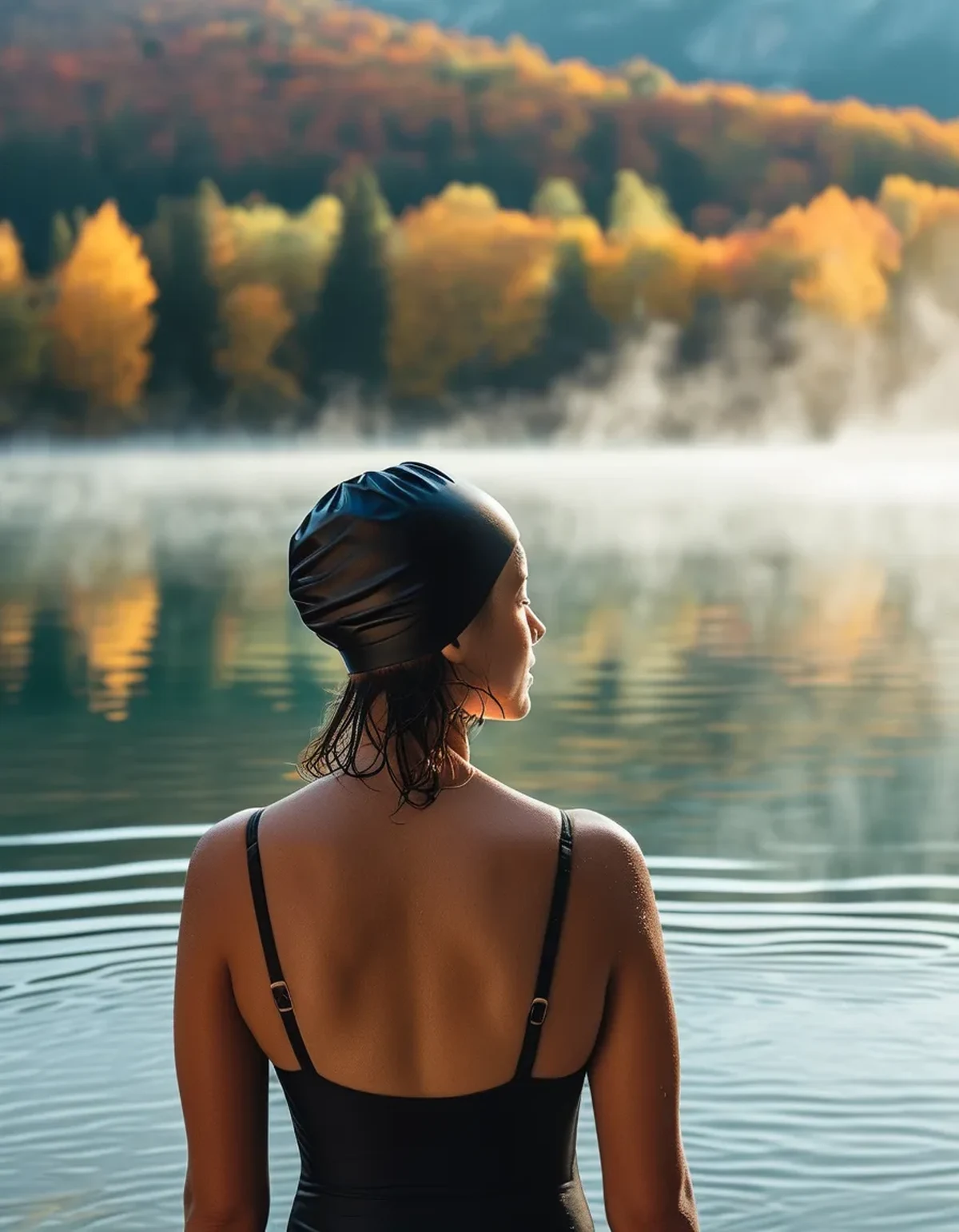
- A bright swim cap, and two if it is cold. Visibility is a safety item, not a style one.
- A tow float, which provides both visibility and something to hold
- Changing robe and warm layers ready before you get in, not after
The post-swim routine that matters:
- Dry and dress immediately, starting with the top half
- A warm - not hot - drink
- Gentle movement to generate heat internally
- Do not drive until you have properly warmed, since afterdrop can affect concentration
On the claimed benefits: research on cold water immersion is active and genuinely interesting, with reasonable evidence around mood and some around inflammatory markers, but many claims outrun the evidence. The most consistently reported benefit is the mood effect, which people describe as lasting hours.
Myth vs Fact: Cold Water in Autumn
Myth: If you swam all summer you will be fine in October. Fact: adaptation fades within weeks of stopping and the water is several degrees colder. Summer experience is not autumn preparation unless the swimming has been continuous.
Myth: A hot shower afterwards is the right way to warm up. Fact: it accelerates peripheral circulation and can worsen afterdrop, and the sudden temperature change places additional stress on the cardiovascular system. Layers, movement and a warm drink are the recommended approach.
Myth: Feeling fine in the water means you are fine. Fact: cold impairs judgement, and swim failure develops without much warning. The absence of distress is not evidence of safety - which is why time limits and a buddy matter more than how you feel.
Myth: Shivering means you should stay in and tough it out. Fact: shivering is a clear signal to get out. Stopping shivering while still cold is a more serious signal and warrants urgent warming.
Myth: Cold plunging burns significant calories through brown fat activation. Fact: cold exposure does activate brown adipose tissue and increase energy expenditure, but the magnitude in humans is modest. It is not a meaningful weight management tool, whatever else it does.
FAQ: Cold Water Swimming in Autumn, Answered
When does open water actually get cold?
It peaks in late August or early September and then drops steadily through autumn, often several degrees a month. The water lags the air by weeks in both directions.
How long should I stay in?
It depends on temperature and adaptation. A widely used heuristic among cold water swimmers is one minute per degree Celsius, treated conservatively. Always get out earlier than you think you need to.
Why do I feel worst after getting out?
Afterdrop - cooled blood from the limbs returns to the core and continues lowering your temperature after exit. Warm gradually with layers and movement rather than a hot shower.
Can I keep swimming through winter?
Many people do, but only with continuous exposure through autumn. Stopping for several weeks removes adaptation, and re-entering cold water without it is a different and more serious proposition.
Who should avoid cold water immersion?
Anyone with a heart condition, uncontrolled hypertension, cold-triggered asthma, or who is pregnant should speak to a doctor first. Cold immersion places significant acute stress on the cardiovascular system - this is general information, not medical advice.
TL;DR:
- Water peaks in late August and drops several degrees a month through autumn
- Swimming consistently through the cooling builds real adaptation; a few weeks off removes it
- Cold shock in the first minute is the main acute risk - enter slowly and control breathing
- Afterdrop means you feel worst 10 to 20 minutes after exit; warm with layers, not hot showers
- Never swim alone, cover hands and feet, and get out before you think you need to
The next six weeks are the window where autumn swimmers are made. Go often, stay briefly, and let the season do the progression for you.
Keep Reading
This article is for general informational purposes only and is not medical advice. Always consult a qualified health professional for guidance specific to you.