What an Evening Cold Plunge Actually Does to Your Sleep
Quick Answer: An evening plunge has two competing effects. The cold triggers a sympathetic response - adrenaline and noradrenaline rise sharply and stay elevated for a while - which is arousing, not calming. But cold immersion also lowers core temperature, and a falling core temperature is one of the physiological signals for sleep onset. Which effect dominates depends mostly on timing and duration. The practical version: keep evening plunges short, finish at least 90 minutes before bed, and rewarm passively rather than with a hot shower. If you use plunging as a wind-down and sleep well, keep doing it - but if you plunge at 9pm and lie awake, this is the likely reason.
The calm you feel afterwards is real. It is also arriving on top of a large adrenaline release, which is a stranger combination than it feels.
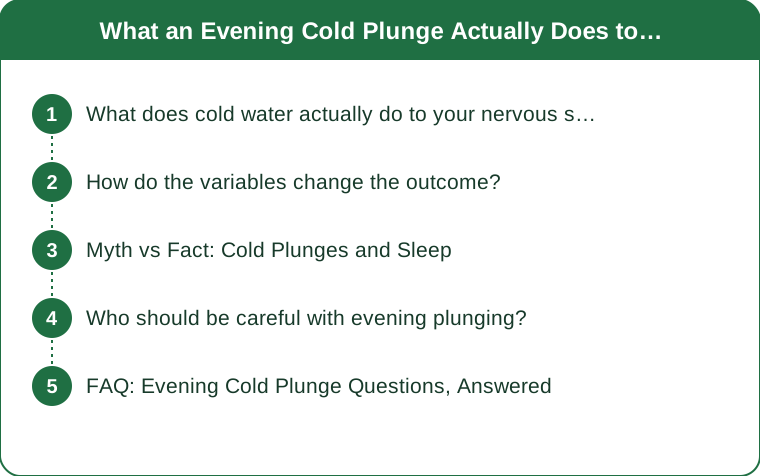
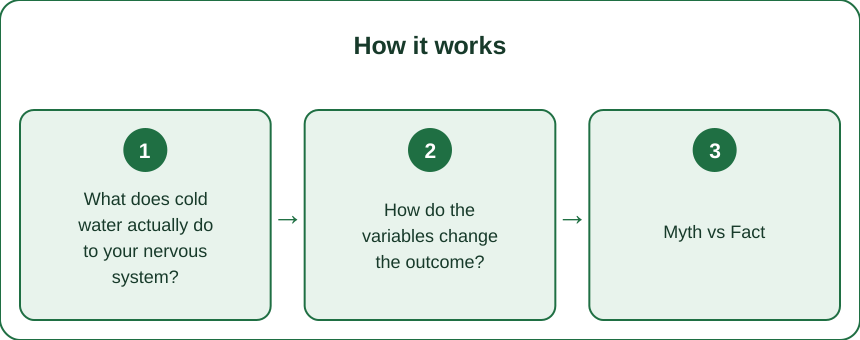
What does cold water actually do to your nervous system?
It produces a sharp, measurable stress response that then resolves into something quite different - and the two phases are often confused.
Phase one, the first 30 to 90 seconds. The cold shock response: an involuntary gasp, a rapid rise in heart rate and blood pressure, peripheral vasoconstriction, and a surge of noradrenaline. Studies of cold water immersion have found noradrenaline rising substantially - by multiples of baseline - and remaining elevated for a considerable period afterward. This is a sympathetic activation, the same branch of the nervous system involved in alertness and stress.
Phase two, after you get out. Breathing settles, the vasoconstriction gradually reverses, and most people report a distinct calm, clear-headed state. Part of this is the parasympathetic rebound after a sympathetic spike; part is likely the dopamine elevation that cold exposure also produces, which is slower to rise and considerably slower to fall.
The key point for evening timing: the calm you feel is not sedation. It is a post-arousal state that sits on top of raised catecholamines, and those take time to clear. Feeling relaxed at 9:30pm does not mean your physiology is in a sleep-ready condition.
Then the temperature effect runs on a separate track. Immersion pulls heat out of the body, and if you are in long enough or cold enough, core temperature falls - which is a sleep-promoting signal, since sleep onset is associated with a declining core temperature. That effect points the opposite direction from the adrenaline.
Which is why the answer is genuinely it depends - and why the variables that decide it are duration, temperature, and how long before bed.
How do the variables change the outcome?
Timing before bed is the biggest lever.
- Under 60 minutes before bed: the arousal effect is most likely to dominate. Noradrenaline is still elevated, and the vasoconstriction from cold actively works against the heat-dumping through hands and feet that sleep onset needs.
- 90 minutes to 3 hours before bed: the usual sweet spot. Catecholamines have largely settled, and if there was a core temperature drop it has resolved into a normal falling curve.
- More than 4 hours before bed: essentially no interaction. This is the safest choice if you have had trouble.
Duration matters, and shorter is better in the evening. Two to three minutes is enough for most of the reported benefits. Longer immersions produce a larger core temperature drop and a bigger catecholamine response, both of which raise the odds of interfering with sleep. Evening is not the session to extend.
Temperature interacts with duration. Colder water shortens the time needed for the same effect. A very cold, very short exposure and a milder, longer one are not equivalent physiologically, and for evening use the milder version is usually easier to sleep after.
How you rewarm matters more than people expect. A hot shower immediately afterward feels wonderful and reverses the core cooling that would otherwise help you sleep, while also causing rapid vasodilation. Passive rewarming - dry off, put warm loose clothing on, move gently, have a warm (not hot) drink - keeps the temperature curve heading the right way.
Individual variation is large. Some people are reliably alerted by cold and some reliably calmed, and the difference is not well predicted by anything obvious. Two weeks of your own data beats any general rule here, which is genuinely the honest answer.
Myth vs Fact: Cold Plunges and Sleep
Myth: Cold is calming, so it must help you sleep. Fact: The immediate response is a sympathetic surge with a large noradrenaline release. The calm arrives afterward as a rebound. Both are real, and only the second one is sleep-compatible.
Myth: A hot shower after the plunge completes the routine. Fact: It undoes the core cooling that helps sleep onset, and it is also thought to blunt some of the adaptations people plunge for. Passive rewarming is the better default in the evening.
Myth: If it makes you tired afterward, it is helping your sleep. Fact: Post-plunge tiredness is partly the metabolic cost of thermoregulation. Feeling tired and being physiologically ready for sleep are different states, and the arousal can still surface as difficulty staying asleep later in the night.
Myth: Cold plunging is a good substitute for a wind-down routine. Fact: It is a high-intensity stimulus, closer in character to a hard training session than to stretching or reading. Treating it as the calm part of the evening is a category error that catches a lot of people out.
Myth: Everyone should avoid evening plunges. Fact: Plenty of people plunge in the evening and sleep well, and morning is not always practical. The rule is not never - it is short, early enough, and passively rewarmed, then check your own results.
Who should be careful with evening plunging?
Cold water immersion is a genuine cardiovascular stressor, and the evening version adds nothing to the risk profile but does not reduce it.
Talk to a professional before starting if you have any heart condition, high blood pressure, arrhythmia, a history of fainting, Raynaud’s, or are pregnant. The cold shock response raises heart rate and blood pressure abruptly, and that is the mechanism behind the cautions.
Never plunge alone, and never in open water alone at night. Cold water incapacitation is fast and the failure mode is severe.
Do not plunge after alcohol. Alcohol impairs thermoregulation, blunts judgement, and increases risk substantially.
Approach with care if you are already sleeping badly. Adding a strong stimulus to an evening when sleep is already fragile is difficult to evaluate. Fix the sleep first, then reintroduce the plunge and see what it does.
Consider the training interaction. Cold immersion soon after strength training appears to blunt some of the muscle adaptation, so if your training is in the evening and hypertrophy or strength is the goal, that is a separate reason to leave several hours or move the plunge to a non-training day.
How to test it properly on yourself. Keep it simple: two weeks plunging in the evening, two weeks not, everything else held constant, and record time to fall asleep, number of night wakings, and how you feel on waking - not a device’s sleep score, which is too noisy for a comparison this size. If the evening version is worse, move it earlier before abandoning it.
This is general information, not medical advice. If you have any cardiovascular condition or are pregnant, speak to a professional before beginning cold water immersion.
FAQ: Evening Cold Plunge Questions, Answered
How long before bed should I finish?
Ninety minutes is a reasonable minimum, and two to three hours is safer if you are sensitive. Under an hour is where most people report trouble.
Is a cold shower different from a plunge for this?
Milder on all counts - less surface area, less heat loss, a smaller catecholamine response. A cold shower in the evening is far less likely to interfere, which makes it the sensible starting point if you want the ritual without the risk to sleep.
Why do I feel sleepy right after and then wide awake at bedtime?
The immediate tiredness is thermoregulatory effort. The alertness later reflects catecholamines that were still on their way up when you got out. That specific pattern is a strong argument for moving the session earlier.
Does the sauna-then-plunge combination change things?
It adds a large heat load, and finishing on cold versus finishing on heat produces different temperature curves into the evening. Finishing warm and allowing a gradual cool tends to sit better before bed for most people, though the whole session is stimulating either way.
Will I adapt so it stops affecting my sleep?
Regular cold exposure does blunt the shock response over weeks - the gasp reflex and the subjective severity both reduce. Whether the sleep interference reduces proportionally is less clear, so keep checking rather than assuming.
TL;DR:
- Cold immersion produces a sympathetic surge with a large noradrenaline release, then a calm rebound. The calm is not sedation.
- It also lowers core temperature, which is sleep-promoting - so the two effects genuinely compete.
- Finish 90 minutes to 3 hours before bed, keep it to 2 to 3 minutes, and rewarm passively rather than with a hot shower.
- A hot shower afterwards undoes the useful cooling. Warm loose clothes and a warm drink instead.
- Test it on yourself over two weeks using time to fall asleep and night wakings - individual variation here is larger than any general rule.
If you plunge at 9pm and then lie awake at 11, you have found your answer. Move it earlier before you give it up.
Keep Reading
This article is for general informational purposes only and is not medical advice. Always consult a qualified health professional for guidance specific to you.