When to Cold Plunge Around Strength Training - and When Not To
Quick Answer: Cold water immersion immediately after resistance training appears to blunt some of the muscle and strength adaptations you were training for - the effect is most consistently reported for strength work and much less of a concern for endurance training. If you want both, separate them by several hours, or plunge on rest days and after endurance sessions instead. For recovery between same-day competitions or heavy sessions, the immediate plunge still makes sense.
The plunge feels like the reward for the workout. It may also be undoing part of it.

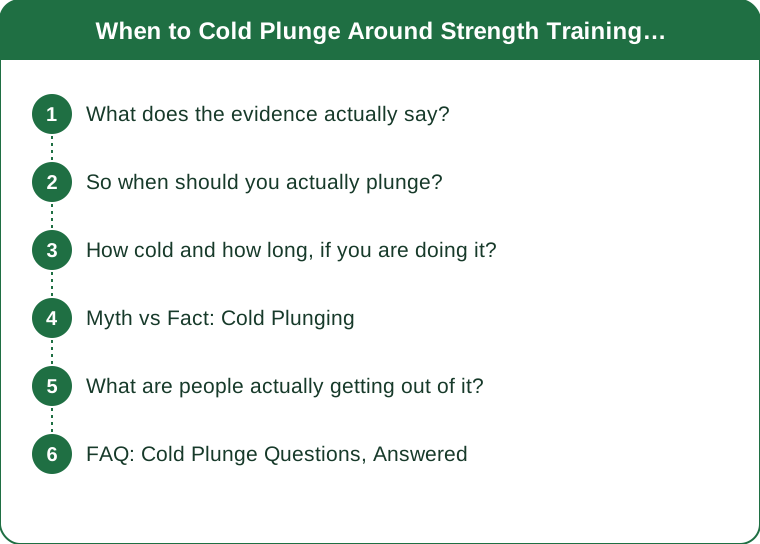
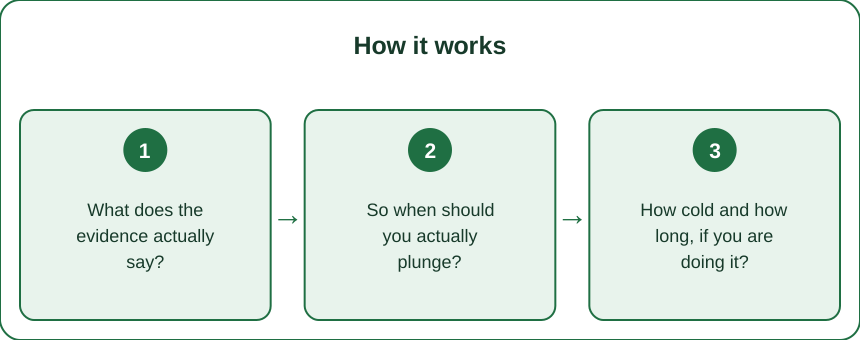
What does the evidence actually say?
It is more specific than either the enthusiasts or the sceptics suggest, and the distinction that matters is what you are training for.
For resistance training adaptations: multiple studies have found that regular cold water immersion immediately after strength sessions attenuates gains in muscle size and strength compared with passive recovery. This is one of the more consistent findings in the area, and it has been replicated across several research groups.
The proposed mechanism: the inflammatory and signalling response after resistance exercise is part of how the adaptation happens. Cold immersion reduces that response - which is exactly what makes it feel good and exactly why it may reduce the adaptation.
For endurance training: the picture is different. Cold immersion does not appear to blunt endurance adaptations in the same way, and it may help with recovery between sessions.
For acute recovery: cold immersion does reduce perceived soreness and can improve short-term performance recovery - which is genuinely useful in a tournament, a two-a-day, or a competition block.
So the answer is conditional: if your goal is muscle and strength, immediate post-lifting plunging is working against you. If your goal is feeling recovered enough to perform again soon, it is working for you. These are different goals and they call for different timing.
So when should you actually plunge?
Four workable timings, depending on what you are training for.
Option 1 - Separate by several hours. Lift in the morning, plunge in the evening. The adaptation signalling is most active in the hours immediately after training, so putting distance between them preserves more of it. Commonly suggested separations run from about 4 to 6 hours upward, and more is presumably better if convenient.
Option 2 - Plunge on rest days. Cleanest solution. You get the subjective benefits with no interference with a training session at all.
Option 3 - Plunge after endurance sessions rather than strength ones. The concern is specific to resistance training adaptations, so a plunge after a run or a ride carries much less of a trade-off.
Option 4 - Plunge before training, or in the morning independent of it. Many people use cold exposure for alertness and mood rather than recovery, and that use has no interaction with training adaptation at all.
When the immediate post-lift plunge still makes sense:
- Competition days with multiple events
- Two sessions in the same day where you need to perform in the second
- Training blocks where recovery is the priority over adaptation - during a competitive season rather than an off-season
- When the alternative is not training at all because the soreness is too much
How cold and how long, if you are doing it?
The commonly used protocols are less extreme than the internet suggests.
Temperature: most research protocols use roughly 10 to 15 degrees Celsius, about 50 to 59 Fahrenheit. Colder is not better and increases risk - the physiological response plateaus and the danger does not.
Duration: commonly 10 to 15 minutes at those temperatures, and shorter at lower temperatures. Many popular protocols suggest a few minutes total per session accumulated across a week, which is considerably less than people assume.
Immersion depth: to the neck in research protocols; legs-only immersion is common in practice and produces a smaller effect in both directions.
Breathing matters more than toughness. The cold shock response - an involuntary gasp followed by hyperventilation - is the genuinely dangerous part, and it is worst in the first 60 seconds. Enter slowly, control your breathing, and never plunge alone in open water.
Safety notes worth taking seriously:
- Never do this alone in open water. Cold shock has caused drownings in strong swimmers.
- Heart conditions, high blood pressure, and pregnancy warrant medical advice first. Cold immersion raises blood pressure and heart rate acutely.
- Do not combine with alcohol.
- Get warm gradually afterwards - not with a hot shower immediately, which can cause dizziness.
This is general information, not medical advice, and cold immersion is one of the areas where the individual medical caveats genuinely matter.

Myth vs Fact: Cold Plunging
Myth: Colder is better. Fact: The commonly studied range is around 10 to 15 degrees Celsius. Going substantially colder increases the cold shock response and the risk without a corresponding benefit.
Myth: Cold plunging burns significant calories through brown fat activation. Fact: Cold exposure does activate brown adipose tissue and the energy expenditure involved is modest. It is not a meaningful weight management strategy.
Myth: If it reduces inflammation it must be good for recovery. Fact: Some post-exercise inflammation is the adaptation signal. Reducing it improves how you feel and can reduce what you gain. Whether that trade is worth it depends entirely on your goal.
Myth: The benefits are all placebo. Fact: Reductions in perceived soreness and acute performance recovery are reasonably well supported, as are acute changes in mood-related neurochemistry. Some claimed benefits are less well established, but the category is not empty.
Myth: You should plunge every day for the benefits. Fact: Most protocols use a few sessions a week. Daily immersion, particularly after strength training, maximises the interference effect with no evidence of a corresponding gain.
Myth: A cold shower is basically the same thing. Fact: A cold shower produces a weaker stimulus - less surface area, less consistent temperature, shorter typical duration. It is not equivalent, and it is also considerably safer, cheaper, and more sustainable, which for the mood and alertness uses may be the more relevant point.
What are people actually getting out of it?
Worth separating the well-supported outcomes from the aspirational ones, because they lead to different decisions.
Reasonably supported:
- Reduced perceived muscle soreness in the days after hard exercise
- Faster short-term recovery of performance between closely spaced sessions
- Acute mood elevation and alertness - the post-plunge feeling is a real neurochemical response, not imagination
- A sense of accomplishment and discipline, which is a genuine and frequently underrated reason people keep doing it
Less established, or more nuanced than claimed:
- Long-term immune benefits
- Metabolic and weight effects, which are small
- Broad claims about longevity and chronic inflammation
Actively counterproductive in one specific case: muscle and strength adaptation, when done immediately after resistance training.
A reasonable conclusion for most people: if you enjoy it and it makes you feel good, that is a sufficient reason to do it - just do it at a time that does not compete with your strength training. Rest days and mornings are free of trade-offs entirely.
And if you are training specifically to build muscle or strength, the simplest rule is: do not plunge in the hours right after lifting. Everything else about the practice can stay exactly as it is.
FAQ: Cold Plunge Questions, Answered
How long after lifting is it safe to plunge?
Several hours is the common suggestion - roughly 4 to 6 or more. The further from the session, the less interference with the adaptation signalling.
Does this apply to cold showers too?
The interference findings come from full immersion protocols. A cold shower is a weaker stimulus and presumably has a smaller effect in both directions, though it is less studied.
Is it fine to plunge after cardio?
The adaptation-blunting concern is specific to resistance training. Cold immersion after endurance work does not show the same pattern and may aid recovery.
What temperature should I aim for?
Around 10 to 15 degrees Celsius, 50 to 59 Fahrenheit, for roughly 10 to 15 minutes. Colder adds risk rather than benefit.
Who should not cold plunge?
Anyone with a heart condition, uncontrolled high blood pressure, Raynaud’s, or who is pregnant should get medical advice first. Never plunge alone in open water, and never after drinking. This is general information, not medical advice.
TL;DR:
- Cold immersion right after strength training appears to blunt muscle and strength adaptations
- The concern is specific to resistance training - endurance adaptation is not affected the same way
- Separate by several hours, or plunge on rest days and after cardio instead
- Around 10 to 15C for 10 to 15 minutes; colder adds risk, not benefit
- Immediate plunging still makes sense for competition days and back-to-back sessions
The plunge is not the problem. Doing it in the two hours after you lift is.
Keep Reading
This article is for general informational purposes only and is not medical advice. Always consult a qualified health professional for guidance specific to you.