Is There an Actual Difference Between a Cold Plunge and an Ice Bath?
Quick Answer: In casual use the terms are often interchangeable, but technically an ice bath specifically includes added ice to reach lower temperatures (typically 50°F/10°C or below), while a cold plunge can refer to any cold-water immersion, sometimes chiller-cooled to a similar range without needing actual ice — the practical effects are nearly identical at matching temperatures, so the distinction matters less than the actual water temperature reached.
The two terms get used as if they’re describing different practices, but the meaningful variable is really the temperature, not whether ice was literally involved.

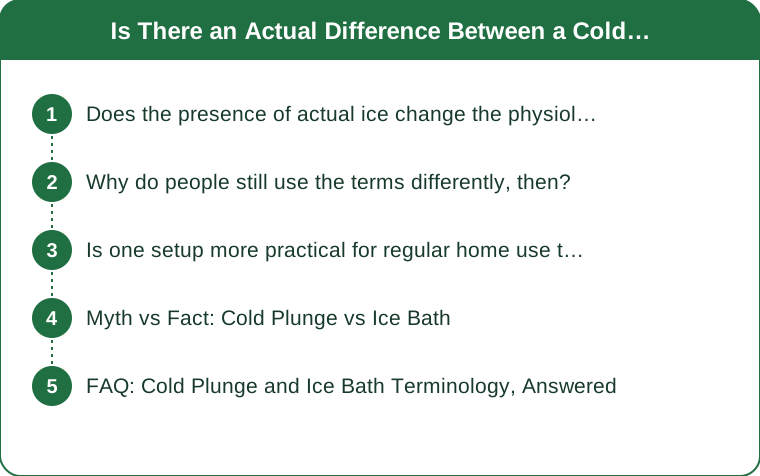
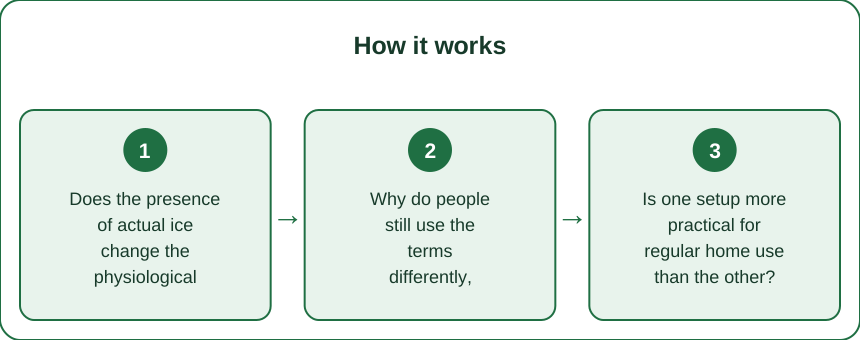
Does the presence of actual ice change the physiological effect?
No — the body responds to water temperature itself, not to whether that temperature was achieved with ice or a chiller system, so a chiller-cooled cold plunge tub at 50°F produces essentially the same physiological response as an ice bath at the same temperature.
Why do people still use the terms differently, then?
‘Ice bath’ tends to be used for improvised setups (a bathtub with bagged ice) while ‘cold plunge’ has become associated with dedicated equipment (chiller-cooled tubs or barrels), which is more about the setup and marketing than an actual meaningful physiological distinction.

Is one setup more practical for regular home use than the other?
A dedicated cold plunge tub with a chiller is more convenient for frequent use since it maintains a consistent temperature without needing repeated ice purchases, while an ice bath setup is cheaper to start but more effort to maintain for regular practice.
Myth vs Fact: Cold Plunge vs Ice Bath
Myth: A cold plunge is inherently less intense than an ice bath. Fact: Intensity depends entirely on the actual water temperature reached, regardless of whether ice or a chiller was used to get there.
Myth: You need real ice for the practice to be effective. Fact: A chiller-cooled tub at the same temperature produces the same physiological response as an ice-cooled bath.
FAQ: Cold Plunge and Ice Bath Terminology, Answered
What temperature range is generally considered a true cold plunge or ice bath?
Most cold exposure research and practice defines the effective range as roughly 50-59°F (10-15°C), with some experienced practitioners going lower, though beginners are usually advised to stay toward the warmer end of that range.
Is a cold shower an adequate substitute for either?
A cold shower is milder and generally doesn’t reach the same low temperatures as a proper plunge or bath, making it a reasonable lower-intensity alternative rather than a full substitute.
Does the container type (tub, barrel, bathtub) matter beyond temperature?
Not meaningfully for the physiological effect — the container mainly affects convenience, cost, and how long the target temperature is easy to maintain, not the core cold-exposure benefit itself.
TL;DR:
- Water temperature, not the presence of literal ice, is what actually matters physiologically
- ‘Ice bath’ and ‘cold plunge’ differ mainly in association (improvised vs dedicated equipment)
- A chiller-cooled tub produces the same effect as an ice-cooled bath at matching temperatures
- Most effective cold exposure happens in the roughly 50-59°F range regardless of setup type
The terminology debate is mostly semantic — what actually determines the effect is the number on the thermometer, not whether ice was technically involved.
Keep Reading
This article is for general informational purposes only and is not medical advice. Always consult a qualified health professional for guidance specific to you.