Cold Showers vs Cold Plunges: What You Actually Get From Each
Quick Answer: They are the same stimulus at very different doses. A plunge immerses nearly all of you in controllably cold water, delivering the full alertness-and-mood response and meaningful post-endurance cooling; a shower hits a fraction of your surface at whatever temperature your tap happens to run - a lighter dose that still wakes you up and builds the habit for free. For mood and morning momentum, the shower does most of the job. For the full physiological experience or serious cooling, immersion wins. For strength gains, keep both away from the hours right after lifting.
The honest framing is not which one is real - it is how much dose you need for the benefit you are actually chasing. And in August, there is a twist: your cold tap is not very cold right now, which quietly changes the math.

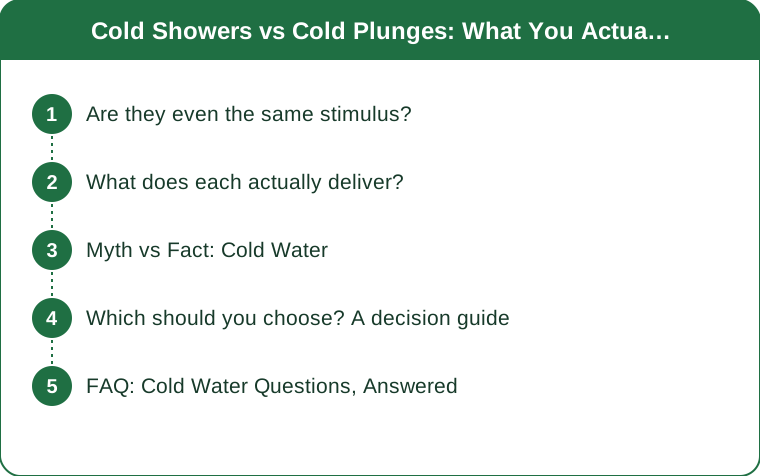
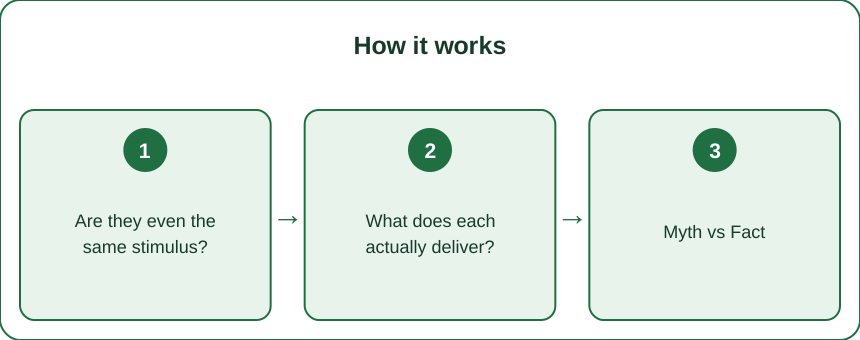
Are they even the same stimulus?
Same category, different magnitude - and the differences are worth being precise about.
Surface area. A plunge submerges you to the neck: close to your entire skin surface reads cold simultaneously, which is what triggers the full-scale response - the gasp, the surge of alertness, the racing calculation about your life choices. A shower contacts whatever the stream touches, a fraction of that surface at any moment. Less skin recruited, smaller alarm.
Temperature control. A plunge is set: 45, 50, 55 degrees, your choice, held by ice or a chiller. A shower bottoms out at whatever your municipal supply runs - and here is the late-summer catch: after months of warm ground, tap water in much of the country arrives in the 70s, barely brisk. The same cold shower habit is a genuinely different dose in February, when the pipes run into the 40s and 50s, than in August. People who find summer cold showers underwhelming are not imagining it.
Hydrostatic pressure. Immersion adds gentle whole-body water pressure that assists circulation - part of why athletes have historically used cold water immersion, not cold spraying, for recovery. Showers have no equivalent.
Quantifiability. A plunge gives you clean numbers - temperature and minutes - which makes progression and consistency measurable. A shower gives you a guess. None of this makes the shower fake; it makes it a lighter, less controlled dose of the same input.
What does each actually deliver?
Where the plunge earns its hype: the acute mood-and-alertness response is real and robust - cold immersion reliably produces a large release of norepinephrine and the accompanying sharp, energized, oddly cheerful state that lasts hours for many people. It is also the proven tool for cooling an overheated body after hot-weather endurance work, and for the subjective heavy-legs relief endurance athletes chase after long efforts. If the ritual itself matters to you - the commitment, the timer, the small ceremony of it - the tub is the version with gravity.
Where the shower quietly competes: the wake-up effect and mood lift show up at shower dose too - ending a normal shower with 30 to 90 cold seconds produces a real alertness bump, and one well-known trial found regular hot-to-cold showers associated with fewer sick days taken, though interestingly not fewer illnesses reported. The shower also wins every practicality contest: zero dollars, zero setup, zero maintenance, and available in every hotel and apartment on earth - which matters because consistency, not intensity, is where habit benefits live.
Where honesty is required about both: the widely claimed metabolism, immunity, and depression benefits rest on evidence that is thinner than the marketing - promising signals, small studies, plenty of placebo room. And the clearest negative finding belongs to lifters: cold immersion in the hours right after strength training blunts some of the muscle adaptation you just trained for. Whichever format you use, keep it away from the post-lifting window - morning plunges with evening lifting, or cold on rest days, sidestep the conflict entirely.

Myth vs Fact: Cold Water
Myth: A cold shower does nothing unless the water is freezing. Fact: The response scales with dose, but it does not require misery to begin. Even moderately cool water on a warm body produces the breathing response and alertness shift. A lighter dose done daily beats a heroic dose done twice.
Myth: Longer is better. Fact: Benefits front-load into the first minutes; risk back-loads into the long ones. Common practice for plunges settles around one to five minutes at moderate cold - past that you are buying shiver and numb toes, not extra adaptation.
Myth: Cold plunges melt fat. Fact: Cold exposure does activate brown fat and burn extra calories - in amounts that round to a snack. As a fat-loss tool it is a rounding error with great production values.
Myth: The gasp means you are doing it wrong. Fact: The gasp and the minute of frantic breathing are hardwired cold shock physiology, not weakness - and they are exactly why you never plunge alone, never jump into open cold water without control, and always enter gradually. The reflex is also the real danger window for anyone with heart conditions.
Myth: You have to plunge daily or lose the benefits. Fact: There is no established daily requirement. The mood effect is per-session; the habit effect follows whatever schedule you keep. Three intentional sessions beat seven resented ones.
Which should you choose? A decision guide
Choose the shower if your goal is: morning momentum, a mood tool you will actually use, a first experiment with cold, or a travel-proof habit. Protocol: normal shower, then 30 to 90 seconds as cold as the tap allows, breathing slow and long through it. In late summer, when the tap runs warm, extend the time slightly or accept the lighter dose - the habit is the asset, and the pipes get colder every week from here.
Choose the plunge if your goal is: the full documented alertness response, post-endurance cooling and recovery, a measured practice you can progress, or - real reason - the ritual that makes you feel like you did something hard before 8am. Protocol: start around 55 to 60 degrees for one to three minutes, enter slowly, exhale long, get out while you could still stay longer. Warm up afterward by moving - the shiver walk - rather than sprinting to a hot shower.
Either way, respect the two hard rules. Cold water immersion stresses the heart and blood vessels on entry: anyone with cardiac conditions, blood pressure issues, pregnancy, Raynaud’s, or who takes heart medications should clear it with a clinician first. And open water plus cold is its own category of risk - currents, depth, and cold shock together - so natural-water plunging is a with-a-buddy activity, always. This is general information, not medical advice.
And the hybrid most people land on: cold showers as the weekday default, immersion as the weekend event or the post-long-run tool. The daily light dose keeps the habit and the morning edge; the occasional full dose keeps the ritual and the deep cool. Nothing about them is either-or.
FAQ: Cold Water Questions, Answered
Are cold showers as effective as cold plunges?
For mood and alertness, they deliver a meaningful share of the effect at a fraction of the dose - and at zero cost. For full-body cooling, recovery immersion, and the complete physiological response, the plunge is the stronger tool. Same stimulus, different magnitude.
How long should a cold shower or plunge last?
Showers: 30 to 90 cold seconds at the end. Plunges: one to five minutes at moderate cold, entering gradually. In both cases, benefits front-load - leave while you could still stay.
Do cold plunges hurt muscle growth?
Cold immersion in the hours right after strength training appears to blunt some hypertrophy and strength adaptation. Separate cold from lifting by several hours or park it on rest days; endurance sessions are less affected.
Why does my cold shower feel warm in summer?
Because it is - tap water tracks ground temperature and can run in the 70s by late August. Lengthen the cold phase, accept the lighter dose, or add occasional true immersion until the pipes cool down in fall.
TL;DR:
- Same stimulus, different dose: plunges immerse everything at a controlled temperature; showers hit less skin at whatever the tap runs - which in August is not much.
- Mood and wake-up benefits show up at shower dose; full response, recovery cooling, and measurability belong to the tub.
- Keep all cold away from the hours after lifting, cap sessions in minutes not marathons, and never plunge alone in open water.
- The sustainable answer is hybrid: daily cold finish in the shower, occasional true immersion when the goal earns it.
Cold water pays on a dose curve, and both formats are on it. Pick the dose your goal needs - and let the free one carry the streak.
Keep Reading
This article is for general informational purposes only and is not medical advice. Always consult a qualified health professional for guidance specific to you.