How to Restart Cold Exposure When the Water Is Already Cold
Quick Answer: Cold adaptation fades within roughly two to four weeks without exposure, so a summer habit does not carry into October. Restart by shortening duration, not lowering temperature - the water is already colder than your last session, so 1-2 minutes is a full session, not a warm-up. The cold shock response, which is the actual risk, is at its strongest exactly when you are least adapted.
If your last plunge was in August water and your next one is in October water, that is a considerably bigger jump than the calendar suggests. Here is how to make it without a bad experience or a genuine risk.

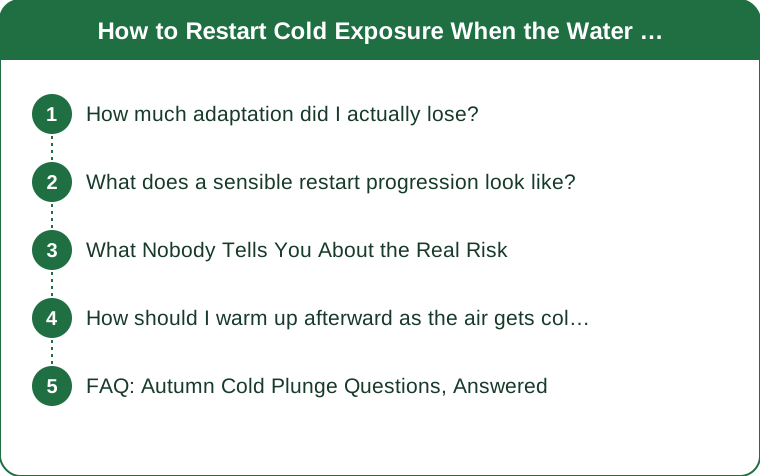
How much adaptation did I actually lose?
Enough to matter, and the specific thing you lost is the thing that keeps you safe.
The primary adaptation from repeated cold exposure is a blunted cold shock response - the involuntary gasp, hyperventilation, and heart rate spike that happen in the first 30-60 seconds of immersion. That habituation develops after roughly five or six immersions and it is the main safety benefit of a consistent practice.
It is also the adaptation that decays fastest, meaningfully reducing within two to four weeks without exposure. Other adaptations - improved peripheral vasoconstriction, better subjective tolerance - persist somewhat longer but also fade over a couple of months.
What makes autumn specific is that the water changed at the same time. Open water and unheated outdoor tubs can drop several degrees over a few weeks in autumn. So you are facing colder water with less habituation than you had - the two variables moving against you at once.
The practical translation is straightforward: treat a restart as a beginning, not a resumption. Whatever your summer duration was is not the relevant number.
What does a sensible restart progression look like?
Short, frequent, and conservative on duration.
Session 1: 30-60 seconds. That is a complete session and it is enough to begin re-establishing habituation. The goal is to get in, control your breathing, and get out while it is still a good experience.
Sessions 2-4: 1-2 minutes. Once your breathing settles within the first fifteen seconds, you have your habituation coming back.
Sessions 5-8: 2-3 minutes. This is where most of the reported benefits sit, and for most people it is a sensible ceiling in cold water rather than a step on the way to something longer.
Frequency matters more than duration. Two or three short sessions a week rebuild habituation far faster than one long weekly session, and they are considerably safer.
The breathing rule that governs everything: you should be able to control your breath within the first 15-20 seconds. If you cannot - if you are still gasping at thirty seconds - the water is too cold for your current level of adaptation, and the correct response is to get out. Not to endure it.
Never chase your old numbers. The single most common autumn mistake is entering with a summer duration in mind and treating anything less as a failure. Duration is an output of adaptation, not a target to be willed.

What Nobody Tells You About the Real Risk
The danger in cold water is almost never hypothermia. It is the first minute.
Cold shock response is an involuntary reaction to rapid skin cooling: a large gasp, followed by uncontrollable hyperventilation for 30-60 seconds, along with a sharp rise in heart rate and blood pressure. In open water, that initial gasp is what drowns people - it happens whether or not your head is under. In a tub it is less immediately dangerous, but the cardiovascular spike is real.
This is why entering slowly matters more than anything else. Lowering yourself over 20-30 seconds rather than jumping blunts the response substantially. Jumping in is the single most common unsafe habit in casual cold exposure and it looks like the confident option.
Second thing nobody mentions: the cardiovascular load is genuine. The combination of cold-induced vasoconstriction and a heart rate spike raises blood pressure sharply. For anyone with a heart condition, high blood pressure, or a history of arrhythmia, cold water immersion is a conversation to have with a clinician before starting, not after. This is general information, not medical advice.
Third: afterdrop. Your core temperature continues falling for 10-20 minutes after you get out, because cold blood from your limbs returns to your core. This is why people feel worse fifteen minutes later than they did at exit, and why the rewarming plan matters as much as the plunge.
Fourth: never alone in open water. In a garden tub the failure mode is unpleasant. In a lake it is fatal, and it has been for very experienced people.
How should I warm up afterward as the air gets colder?
Gradually and actively, and not with the thing everyone reaches for.
Do not get straight into a hot shower. Rapid external rewarming causes peripheral vessels to dilate quickly, which sends more cold blood to your core and can make afterdrop worse - as well as producing dizziness. Wait 10-15 minutes, then warm gradually.
Do this instead:
- Dry off completely and immediately - evaporation is the fastest route to further heat loss, and this matters far more in cool autumn air than it did in August.
- Get dressed in layers, including a hat. Head and neck lose heat quickly.
- Move gently - walking, easy movement, light bodyweight work. Muscle activity generates heat internally, which is the safest way to rewarm.
- Have a warm drink. The psychological effect is bigger than the thermal one, and both help.
- Then, after ten to fifteen minutes, a warm - not hot - shower if you want one.
Set up before you get in, not after. In cold air, fumbling for a towel with numb hands is genuinely miserable and it extends your exposure. Have the robe, the towel, the clothes, and the drink laid out and within reach before you enter the water.
Watch for shivering that will not stop. Prolonged uncontrollable shivering, confusion, or slurred speech means you have gone too far and need active warming and, if it does not resolve quickly, medical attention.
FAQ: Autumn Cold Plunge Questions, Answered
Should I lower the temperature or shorten the time when restarting?
Shorten the time. In autumn the temperature has already dropped for you without your consent, which is exactly the variable you would otherwise control. Duration is the lever you still have, so use it - and if you have a chiller or can add warm water, there is no shame in restarting at a milder temperature and letting the season take you down gradually.
How cold is cold enough to get the benefits?
Most of the commonly cited effects are associated with water in roughly the 10-15C / 50-59F range, and colder is not proportionally better - it mainly shortens safe duration and raises risk. Autumn open water often passes through this range naturally. Chasing ever-colder water is a common pattern and it is not supported by much of anything.
Can I keep this going through winter?
Many people do, with consistent frequency being the requirement - regular exposure maintains habituation, whereas sporadic winter plunges mean facing the coldest water of the year with the least adaptation, which is the worst combination. If you cannot commit to a couple of sessions a week through the cold months, ending the season deliberately in late autumn is a more sensible plan than an occasional heroic January dip.
TL;DR:
- Cold shock habituation fades in two to four weeks, and autumn water is several degrees colder than your last session.
- Restart at 30-60 seconds, build to 2-3 minutes over several short frequent sessions, and never chase summer durations.
- Enter over 20-30 seconds, control breathing within 15-20 seconds or get out, and never plunge alone in open water.
- Rewarm gradually - dry immediately, layer up, move gently, and wait 10-15 minutes before any warm shower because of afterdrop.
The autumn restart catches people because nothing about the routine feels new - same tub, same habit, same person. The water and your nervous system both moved while you were not looking. Go back to short sessions for a fortnight, keep the frequency up, and by the time real winter arrives you will have the adaptation to meet it. This is general information, not medical advice.
Keep Reading
This article is for general informational purposes only and is not medical advice. Always consult a qualified health professional for guidance specific to you.