How to Start Cold Exposure If You Genuinely Hate Being Cold
Quick Answer: Start far smaller than any protocol you’ve read. Finish an ordinary warm shower with fifteen seconds of cold on your limbs only, keeping your head and torso out of it, and add five to ten seconds a week. The gasp reflex - the involuntary sharp inhale on cold immersion - is what makes people hate it, and it’s driven by sudden cold on the chest and face, which is exactly what a limbs-only start avoids. Build to a minute or two over two months, and skip full immersion entirely unless you want it.
Everyone posts about the ice bath. Almost nobody mentions that a fifteen-second cold finish on your legs is a legitimate place to stop, permanently, if that’s what you want.

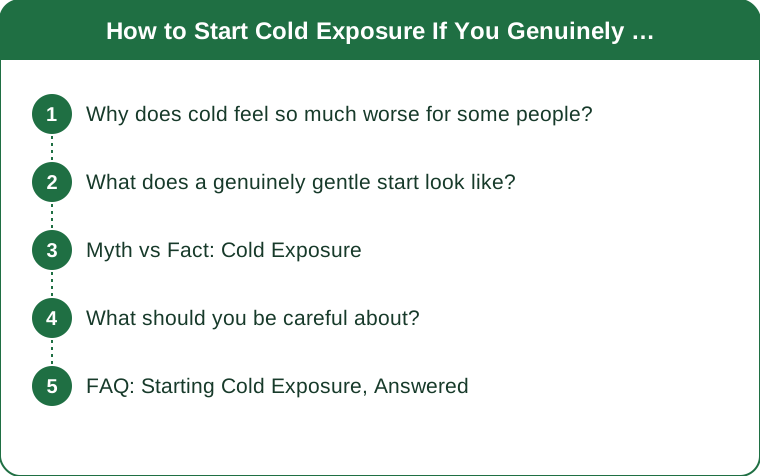
Why does cold feel so much worse for some people?
The cold shock response is involuntary. Sudden cold on the skin, particularly the chest and face, triggers a sharp gasp and rapid breathing. It’s a reflex, not a mindset - which is why willpower alone doesn’t help and why people describe it as panic.
Body composition and habituation both matter. People differ in how quickly they lose heat and how fast they adapt, so two people doing an identical protocol genuinely have different experiences.
Anticipation does much of the damage. For a lot of people the worst part is the thirty seconds before, standing in a bathroom negotiating with themselves. Shortening that window is a real technique.
Most protocols start far too aggressively. Advice built around several minutes in genuinely cold water is written for people already adapted, and starting there is how people conclude they can’t do it.
Cold on top of being cold doesn’t work. Starting a cold exposure practice while already chilled, tired, or under-fuelled makes it far harder and considerably less pleasant.
And there’s no obligation. The benefits claimed for cold exposure range from well-supported to speculative. If you hate it and you don’t want to do it, that’s a complete answer.
What does a genuinely gentle start look like?
Week one: fifteen seconds, limbs only, at the end of a warm shower. Turn the temperature down and put your legs and arms in it. Keep your chest, neck, and face out of the stream. This avoids the main trigger of the gasp reflex.
Add five to ten seconds a week. Not more. The whole point is that the increase is small enough to be unremarkable, which is what makes it sustainable.
Bring your back and chest in around week four, if you want to. By then the limbs are habituated and the transition is much less dramatic than a cold start would have been.
Control the breath deliberately. Slow exhales, longer than the inhales, from the moment the cold starts. Breathing is the single most effective tool available, and it directly counteracts the reflex.
Finish cold rather than starting cold. A warm shower first means you’re not cold going in, which makes the cold portion far more tolerable and easier to repeat.
And warm up naturally afterwards. Dry off, dress, move around, have a hot drink. Jumping straight back into a hot shower undoes the adaptation you’re building and teaches your body nothing.

Myth vs Fact: Cold Exposure
Myth: You need an ice bath to get anything from it. Fact: cold showers are the practical entry point for most people, and consistency at a moderate temperature is generally considered more useful than occasional extremes.
Myth: Colder is always better. Fact: past a point, colder mainly increases risk and unpleasantness. Regular exposure to a manageable cold is the version people actually sustain.
Myth: The panic feeling means you’re doing it wrong. Fact: the gasp and rapid breathing are an involuntary reflex to sudden cold on the chest and face. Avoiding those areas early and controlling your exhale is the technique, not toughness.
Myth: Cold exposure boosts your immune system so you won’t get ill. Fact: some studies have found reduced self-reported sick days with cold showers, but the evidence base is limited and the effect is not the dramatic protection often claimed.
Myth: Cold plunging after every workout is good for recovery. Fact: cold immersion immediately after strength training may blunt some of the muscle-building adaptations you trained for. Separating cold exposure from strength sessions, or using it on rest days, is the more considered approach.
Myth: If you hate it, you should push through. Fact: hating it and doing it anyway for months is a poor trade for benefits that are modest and partly uncertain. There’s no health requirement to plunge.
What should you be careful about?
Never do cold water immersion alone in open water. The cold shock response can be dangerous in open water, and this is a genuinely different risk category from a cold shower. Open water swimming has its own safety practices for good reason.
Heart conditions and cold exposure need medical advice first. Cold immersion causes an abrupt cardiovascular response. This is general information, not medical advice - if you have a heart condition, high blood pressure, are pregnant, or have any circulatory condition including Raynaud’s, ask a clinician before starting.
Stop if you feel dizzy, numb, or if shivering becomes uncontrollable. These are stop signals, not milestones. Getting out is always the correct response.
Don’t combine it with alcohol or do it when unwell. Both change how your body handles cold and both raise the risk.
Time strength training separately. If muscle growth is a goal, keep cold immersion away from the hours immediately after resistance training.
And skip it entirely if it’s making you dread your shower. A practice you dread has already failed at the thing most people are actually after, which is feeling better.
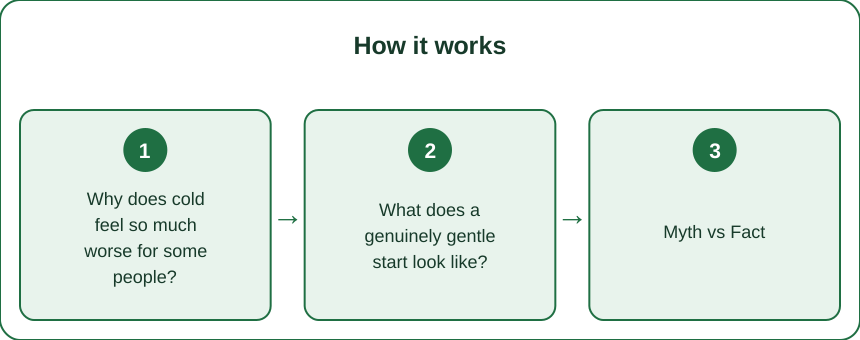
FAQ: Starting Cold Exposure, Answered
How do I start cold showers if I hate the cold?
Finish a warm shower with fifteen seconds of cold on your limbs only, keeping your chest and face out of the stream, and add five to ten seconds a week. Avoiding the chest and face early is what prevents the involuntary gasp reflex.
Why do I gasp when cold water hits me?
It’s the cold shock response - an involuntary reflex to sudden cold on the skin, especially the chest and face. Controlling your exhale and keeping those areas out of the stream at first are the two things that actually help.
Do I need an ice bath, or is a cold shower enough?
A cold shower is a legitimate practice and the sensible entry point for most people. Consistency at a moderate temperature is generally more useful than occasional extreme exposure.
Should I cold plunge after lifting weights?
Probably not immediately after, if muscle growth is your goal - cold immersion straight after resistance training may blunt some of the adaptations. Rest days or a gap of several hours is the more considered approach.
TL;DR:
- Start at fifteen seconds on your limbs only at the end of a warm shower, and add five to ten seconds a week.
- The gasp reflex is involuntary and triggered by sudden cold on the chest and face - avoid those areas early.
- Control your exhale from the first second; breathing is the technique, not toughness.
- Warm up naturally afterwards rather than jumping back into a hot shower.
- Never do open water immersion alone, get medical advice first if you have heart, circulatory, or pregnancy considerations, and separate cold immersion from strength training.
Fifteen seconds on your legs is a real practice. There’s no rule that says you have to end up in a barrel of ice.
Keep Reading
This article is for general informational purposes only and is not medical advice. Always consult a qualified health professional for guidance specific to you.